Image of the month
Step by step: Risk management for calcium oxalate (CaOx)
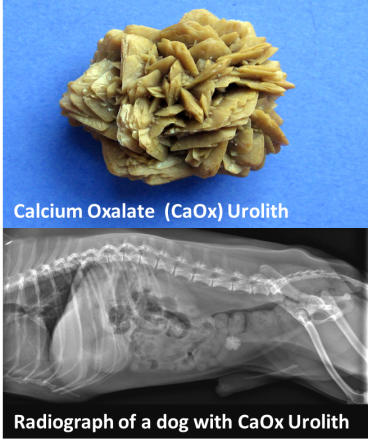
- Correct idiopathic hypercalcemia. Although rare in dogs, it is more common in cats (30%). We do not recommend bisphosphonates or calcimimetics to lower idiopathic hypercalcemia when uroliths are the only reason. The side-effects of these medications can be worse than the uroliths. Consider a diet change where dietary calcium is less than 200 mg/100kcal and the Ca:P ratio is less than 1.4:1 (Ehrlich 2024). If ineffective, add 2 grams of Chia seeds to the cat’s food daily (Fantinati 2020). Some cats revert without therapy.
- Select a CaOx prevention food. Pet food manufacturers meticulously tailor ingredients and test their foods to ensure a reduced urine CaOx precipitation while providing good nutrition.
- Reduce urine specific gravity. In healthy dogs, decreasing urine specific gravity from 1.034 to 1.024 reduced CaOx saturation by 34% (Stevenson 2003). In healthy cats, decreasing USG from 1.053 to 1.036 reduced CaOx saturation by 50% (Buckley 2011). We recommend feeding canned foods or adding water to food to achieve a urine specific gravity below 1.020 in dogs and 1.030 in cats.
- Neutralize urine pH. In healthy cats, alkaline urine (pH=7.03) reduced CaOx saturation by 79% (Bartges 2013). Dogs with aciduria were at higher risk (OR = 1.94) for their first CaOx stone (Okafor 2014). We recommend administering potassium citrate to achieve a urine pH between 6.5 to 7.5.
- Medically image every 6 to 12 months. CaOx is a common and difficult stone to prevent because factors responsible for formation are not completely understood. Stone recurrence detected early, prior to clinical signs and when uroliths are small enough to pass through the urethra can be removed non-surgically by voiding urohydropropulsion.
- Administer hydrochlorothiazide diuretics with highly recurrent stones (recurrence in less than 1 year). Hydrochlorothiazides reduce urine calcium excretion.
See our detailed Canine Calcium Oxalate and Feline Calcium Oxalate Risk management recommendations.
See also: How to adjust potassium citrate to minimize calcium oxalate
- Ehrlich, et al. J Feline Med Surg 2024, 2024 Feb;26(2)
- Fantinati, et al. Front. Vet. Sci. 22 July 2020; Vol 7 - 2020
- Stevenson, et. al. Res Vet Sci. 2003;74:145
- Buckley, et. al. Br J Nutr. 2011;106:S128
- Okafor et al. Prev Vet Med. 2014;115:217-28
- Bartges et al. Am J Vet Res 2013;74:1347–1352
- Lulich et al. J Amer Vet Med Assoc. 2001; 218: 1583-1586