Click to jump to submission form info
Hereditary Calcium Oxalate Urolithiasis, Type 1 (CaOx1) and Type 2 (CaOx2), are two different autosomal recessive genetic disorders that greatly increase the risk for formation of CaOx urinary (bladder or kidney) stones. CaOx1 is caused by a mutation in a protein that is excreted in the urine and is important to preventing crystal formation. CaOx2 is caused by a mutation in a protein that transports electrolytes between the urine and kidney cells.
Who gets CaOx1 & CaOx2?
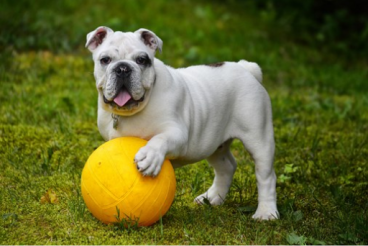
These disorders are rare across the dog population as a whole, but both are common causes of CaOx urinary stones in English Bulldogs.
Additional breeds affected are:
CaOx1 mutation - American Bully, American Staffordshire Terrier, Border Collie, Boston Terrier, Bullmastiff, Havanese, Rhodesian Ridgeback, Rottweiler, and Staffordshire Bull Terrier
CaOx2 mutation - American Bulldog, Basset Hound, Beagle, Bullmastiff, and English Mastiff
We believe that these mutations are likely present in additional breeds, especially those related to the bulldog lineage. If you are interested in testing a breed not listed here, you are welcome to contact us first to obtain information on the likelihood that the mutation exists in your breed of interest.
What are the clinical signs?
CaOx stones can form in the kidneys or bladder. This causes irritation that may manifest as straining to urinate, frequent urination, urgency with urination, blood in the urine, or life-threatening urinary obstructions. Dogs affected by hereditary CaOx1 or CaOx2 can develop stones as puppies or adults with an average age of 3 years at diagnosis. Recurrence is common. Though many patients have serious consequences, some remain asymptomatic. Based on our current data, we estimate that most dogs with CaOx1 will form stones in their lifetime. In contrast, dogs with CaOx2 do not always develop signs of stone disease, as we have detected this disorder in some dogs without a history of stones. With both disorders, males are significantly more likely to form stones than females.
There might be other consequences of these disorders. In humans, mutations in the CaOx2 gene can result in stillbirths, premature births, or neonatal death. We do not know yet whether dogs affected by CaOx2 are at increased risk for in utero or neonatal mortality. Humans with mutations in the CaOx2 gene can also have excessive thirst and urination and electrolyte abnormalities. These signs have not yet been reported in dogs affected by CaOx2. As we learn more, we will update our website with the information.
How is it managed?
Once diagnosed, stones can be treated surgically or with other removal techniques, but the disease tends to recur without additional intervention. Recommendations on preventative measures can be found at the Minnesota Urolith Center:
About CaOx stones (pdf)
CaOx stone dietary guidelines (pdf)
Genetic test results can be used to help guide medical management of affected dogs, identify dogs at risk even before they form stones, and to inform breeding decisions.
Ongoing research
We are currently conducting research to determine which therapies are most likely to reduce stone risk specifically for dogs with hereditary CaOx1 and CaOx2. If your dog is affected, you can help with this research by submitting a urine sample for special analyses in our laboratory (no charge). Please contact us at [email protected] for more information. We will update this website as we learn more about the best treatment for this disease.
Other hereditary stone types in bulldogs
Bulldogs are also reported to be at increased risk for two other hereditary urinary stone types: cystine and urate.
- Cystine stones in most bulldogs are believed to be androgen-dependent (Type 3 cystinuria). Type 3 cystinuria causes stone risk only in intact male dogs, and urine cystine levels normalize with chemical or surgical castration, eliminating risk for additional cystine stone formation. The precise mutation responsible for Type 3 cystinuria is currently unknown, and we therefore do not offer genetic testing for this condition. More information on cystine stones can be found at Canine Cystine (pdf).
- Urate stones in bulldogs are primarily caused by a mutation in the uric acid transporter gene, SLC2A9. This mutation increases uric acid concentrations in the urine (hyperuricosuria, HUU), resulting in risk for urate urinary stones. We offer a genetic test to screen for the HUU mutation. This can be performed alone or as a "combo test" with CaOx1 and/or CaOx2 testing. More information on urate stones can be found at Canine Urate (pdf).
Submitting a sample
Step 1 - Select instructions for your sample type
- Blood sample protocol (pdf)
- Cheek swab protocol (pdf)
- Dew claw & tail docking protocol (pdf)
- Semen sample protocol (pdf)
Step 2 - Complete your submission form(s)
Step 3 - Fees & Payment
Any single test
- 1-3 dogs - $65 each
- 4 or more - $58 each
Any two tests "2 test combo"
- 1-3 dogs - $100 each
- 4 or more - $85 each
CaOx1, CaOx2, & HUU "3 test combo"
- 1-3 dogs - $130 each
- 4 or more - $100 each
Need cheek swabs?
Cheek swabs are not included in the purchase price. Links to several purchasing options are available within the cheek swab protocol (pdf).
Step 4 - Ship your sample(s)
Result interpretation
Scientific references
Calcium oxalate urolithiasis in juvenile dogs.
Saver A, Lulich JP, Van Buren S, Furrow E. Vet Rec. 2021:e141. doi: 10.1002/vetr.141
Related links
University of Minnesota Urology service
Learn more about the work of the Minnesota Urolith Center, which has received more than one million bladder stones for diagnosis and strives to minimize pain and avoid invasive surgery.